
Key Highlights
- Mercedes demonstrated a significant advantage in qualifying over the McLaren team.
- The key to this advantage lies in deployment superiority on the straights.
- McLaren acknowledges the need for improved energy management and aerodynamics.
- The new regulations require teams to focus more on energy strategy and integration.
Mercedes’ Dominance in 2026 Qualifying: A Tale of Deployment Superiority
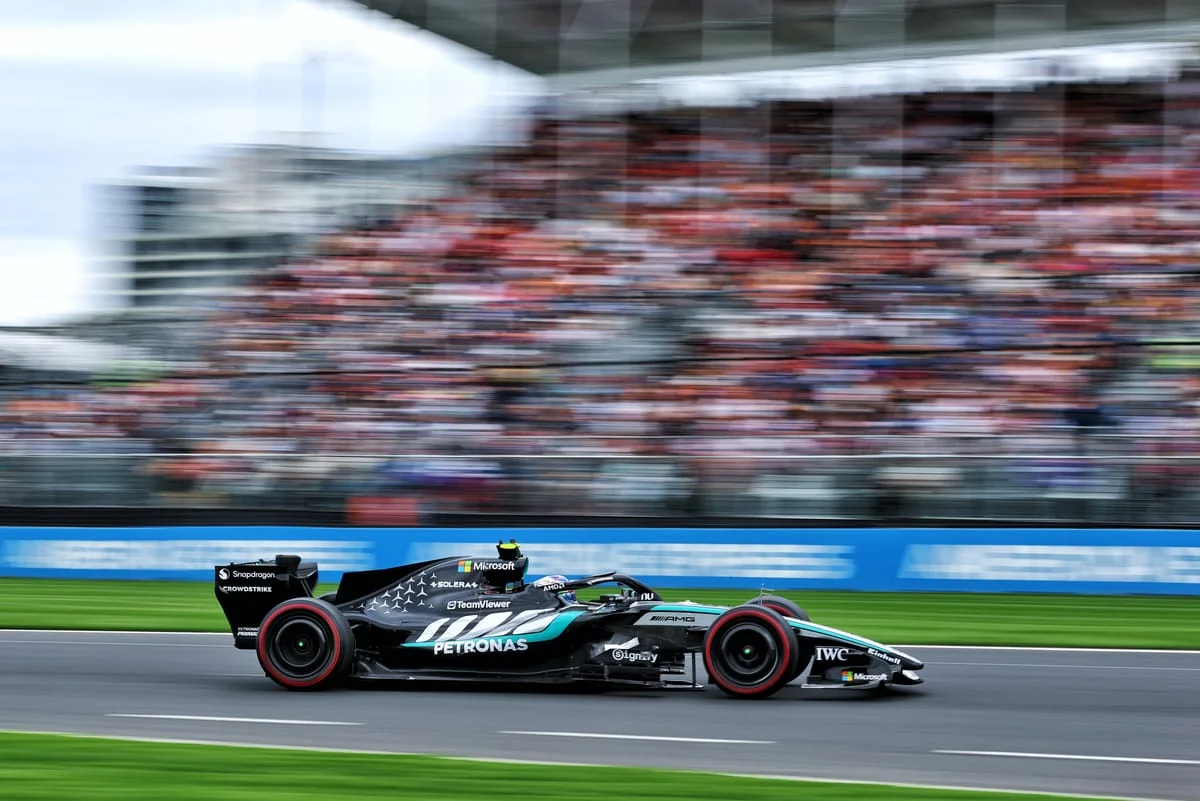
Back in the Formula 1 world, where big Mercedes has claimed a clear advantage over McLaren. This advantage isn’t just about raw power; it’s also about how that power is deployed on the track.
The Power Unit vs. The Car: A Duet of Superiority
Isack Hadjar, driving for Red Bull, noted that despite his eighth pole position, the real margin of victory lies not only in the power unit but also in the car’s chassis quality. “We’ve got a really great engine beneath us,” he stated. “However, we’ve also got a really amazing car beneath us and that probably hasn’t been highlighted enough.”
Qualifying Data: The Back Straight Tells the Story
The back straight is where Mercedes truly shines. According to data from The Race, there’s a point at the exit of Turn 8 when all four cars are traveling at similar speeds—290km/h for Russell and Leclerc, 289km/h for Isack Hadjar, and 291km/h for Oscar Piastri. Yet, by the time they reach Turn 9, there’s a clear gap.
At that critical moment, Russell is up on all three of them with Leclerc 0.225s down, Piastri 0.252s down, and Hadjar 0.332s behind. This difference in speed on the back straight contributes significantly to their overall lap time advantage.
Energy Management and Deployment: The New Language of F1
McLaren’s team principal Andrea Stella highlighted that energy management plays a critical role, saying, “It took qualifying, to be all in the same condition on track, same power unit, to have enough of a reference to understand what is possible. From this point of view, being a customer team doesn’t put you on the front foot.” This statement underscores the importance of understanding and exploiting energy effectively.
Stella also noted that there’s a new era in Formula 1 where teams need to be sensitive to driver input, maximize deployment in straights, and use energy management strategically. This is what Mercedes seems to have mastered better than McLaren.
The Future: A Battle of Car Characteristics
While the current advantage lies with Mercedes due to their superior power unit and handling, over time, this should reduce as other teams like McLaren improve in areas such as aerodynamics. “There are two clear objectives,” said Stella. “One is work together with our HPP partners to get more performance from the power unit; at the same time, we need to improve the aerodynamic performance of the car because we need to go faster in the corners as well.”
This analysis paints a picture where teams will continue to refine their strategies and technologies, but for now, Mercedes is leading the pack with both hardware and strategic execution.
Conclusion
The 2026 Formula 1 season sees Mercedes with an undeniable edge, thanks to their superior deployment strategy on the straights. This doesn’t overshadow the critical importance of energy management and overall car performance. As the race unfolds, we can expect these dynamics to play out in thrilling fashion.