
Key Highlights
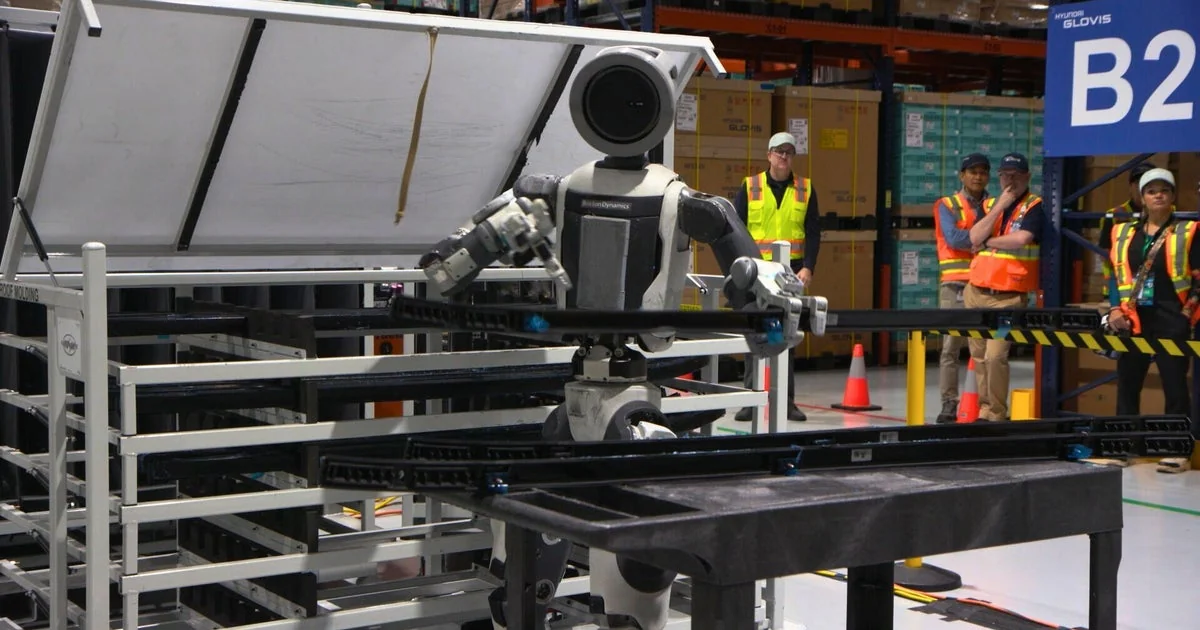
- Boston Dynamics’ humanoid robot Atlas is being tested in a real-world factory setting for the first time.
- The development of human-like robots capable of performing human jobs is seen as a response to fears that AI will displace workers.
- Nvidia’s advanced microchips are powering Atlas, enabling it to perform autonomous tasks with “common sense.”
- Boston Dynamics CEO Robert Playter envisions a future where robots exceed human capabilities in certain areas but assures that such scenarios won’t lead to a world of Terminators.
Revolutionizing the Factory Floor: Boston Dynamics’ Atlas Takes on Real-World Work
Boston Dynamics, a pioneer in robotics, is pushing the boundaries of human-like automation with its AI-powered humanoid robot Atlas. The company’s recent test run at Hyundai’s factory near Savannah, Georgia, marks the first time Atlas has been deployed for real-world work outside the laboratory.
A Step Towards Humanoid Automation
For decades, engineers have been striving to create robots that mimic human behavior and appearance. Now, rapid advancements in artificial intelligence are bringing this vision closer to reality. Atlas, a 5’9″, 200-pound humanoid created by Boston Dynamics, is at the forefront of this technological revolution.
Atlas: Learning Through Experience
Zack Jackowski, an engineer working on Atlas’s development, guided us through his team’s journey in teaching the robot. Using a combination of supervised learning and virtual simulations, engineers like Kevin Bergamin have been instrumental in equipping Atlas with skills such as sorting roof racks for assembly lines.
“The rise of the robots is science fiction no more,” remarked Bill Whitaker during their first on-site visit. Jackowski echoed this sentiment, adding, “This is the first time Atlas has been out of the lab doing real work.”
Nvidia’s Powering Atlas’ Brain
Boston Dynamics turned to Nvidia for its advanced microchips, which are crucial in enabling Atlas to process vast amounts of data and perform tasks autonomously. This integration allows Atlas to navigate complex environments with a semblance of common sense.
“Nvidia chips have been instrumental in advancing AI capabilities,” explained Scott Kuindersma, head of robotics research at Boston Dynamics. “They allow us to process the collected data efficiently, moving closer to a system that can handle tasks as humans would.”
The Future of Work: Humanoids and Beyond
As Hyundai’s South Korean stakeholder, Robert Playter, the CEO of Boston Dynamics, envisions a future where robots like Atlas will be more than just assistants. “We are creating a robot that is meant to exceed human capabilities in certain areas,” he stated during their interview.
However, Playter reassures that such advancements do not equate to a dystopian world depicted by science fiction. “Absolutely not,” he said. “If you saw how hard we have to work to get the robots to perform even straightforward tasks, it would dispel any concerns about sentience and rogue robots.”
Challenges Ahead
Boston Dynamics faces stiff competition from other tech giants like Tesla and state-supported Chinese companies, all vying for a piece of the $38 billion market projected by Goldman Sachs within the decade. The company’s Atlas is one of several humanoids being developed to tackle repetitive and dangerous tasks in various industries.
For now, the focus remains on refining these robots’ capabilities so they can operate seamlessly alongside humans, potentially easing concerns about job displacement while paving the way for a more efficient industrial future.
In conclusion, Boston Dynamics’ Atlas represents a significant leap forward in the integration of human-like robots into real-world work environments. As technology continues to evolve, the potential for these humanoid machines will only grow, reshaping industries and workplaces across the globe.