
Key Highlights
- A new attention-aware resource allocation framework enables scalable VR-cloud gaming with low latency in 6G networks.
- The research introduces a multi-stage optimisation approach that improves user experience by up to 50%, reduces communication resource usage by 75%, and delivers substantial cost savings.
- Scientists have developed specialized heuristic algorithms for each stage, achieving near-optimal performance while significantly reducing processing time.
- This breakthrough addresses the challenges of providing immersive experiences in next-generation mobile networks with stringent bandwidth and delay requirements.
Introduction to VR-Cloud Gaming Challenges
The advent of Virtual Reality (VR) cloud gaming poses significant challenges for future mobile networks. These systems demand substantial bandwidth to transmit high-quality visuals and minimal latency to ensure seamless user experiences. The research by Gabriel Almeida, João Paulo Esper, Cleverson Nahum from the Instituto de Informática at Universidade Federal de Goiás, alongside Audebaro Klautau from Universidade Federal do Pará, and Kleber Vieira Cardoso aims to tackle these issues.
Developing an Attention-Aware Resource Allocation Framework
The researchers propose a novel framework that intelligently allocates network resources, places game engines strategically, and prioritises visual quality based on user attention within the virtual environment. This method demonstrably improves user experience by up to 50%, reduces communication resource usage by 75%, and delivers substantial cost savings.
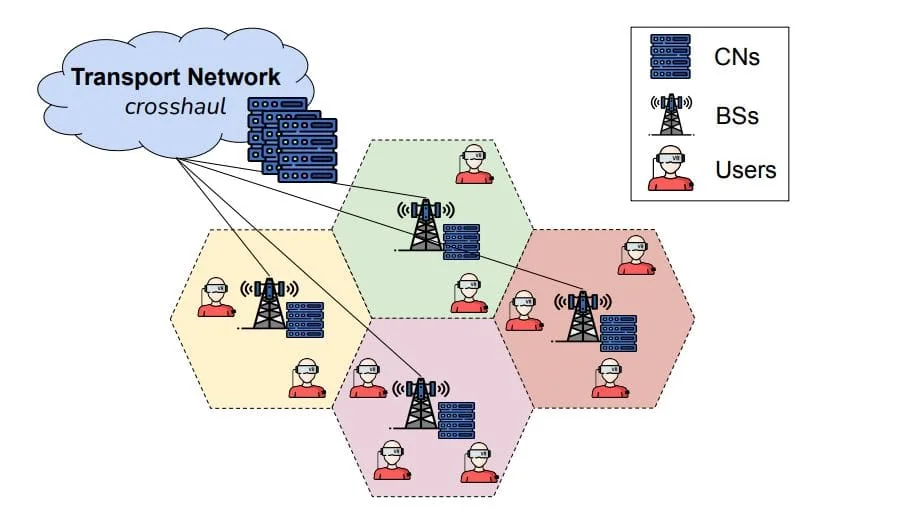
The approach decomposes the complex joint resource allocation problem into three interdependent stages: user association and communication resource allocation, VR-CG game engine placement with adaptive multipath routing, and attention-aware scheduling with wireless resource allocation based on motion-to-latency. Specialized heuristic algorithms were designed for each stage, achieving performance comparable to optimal solutions while solving large-scale scenarios in under 0.1 seconds.
Advancements and Future Directions
The study highlights the importance of a user-centric Quality of Experience (QoE) model based on visual attention to virtual objects. This approach enables prioritisation of video quality in areas where the user is focused, while intelligently compressing peripheral regions, effectively reducing transmission requirements and optimising bandwidth usage.
Experiments employing a dataset-driven evaluation demonstrate these improvements, achieving up to 50% better QoE compared to existing methods, with a 75% reduction in communication resource usage and up to 35% cost savings. The research team acknowledges that further refinement is possible and future work will explore the integration of artificial intelligence and machine learning techniques to enhance adaptability.
The framework’s potential for real-time deployment in next-generation mobile networks makes it a significant breakthrough, addressing the complex challenges of providing immersive experiences with stringent bandwidth and delay requirements. This work not only enhances user satisfaction but also optimises network performance and resource allocation, paving the way for more efficient and scalable VR-cloud gaming solutions.