
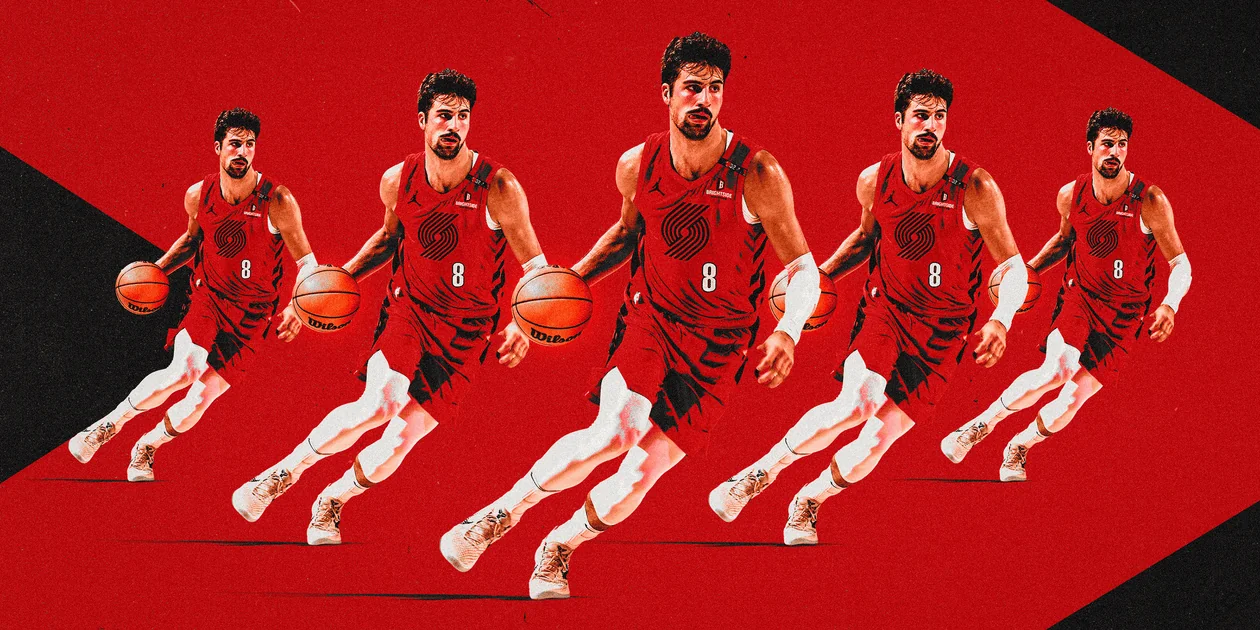
Key Highlights
- Deni Avdija’s unexpected rise to become this season’s breakout star of the NBA and Israel’s greatest player ever.
- Avdija’s tough upbringing in Maccabi Tel Aviv, where he faced constant teasing and criticism from his peers and coaches.
- The transition of Avdija from a bench player to an All-Star candidate under Chauncey Billups’ guidance.
- Avdija’s role as a key player for the Portland Trail Blazers during the 2024-2025 season, despite dealing with injuries and a depleted roster.
The Unlikely Rise of Deni Avdija: From Israeli Basketball Prodigy to NBA Sensation
Portland, Ore. — If there is a place to start when chronicling the rise of Deni Avdija into this season’s breakout star of the NBA, it should be back home in Israel during his youth. The only problem: It involves a tale he doesn’t like to relive.
From Teasing and Criticism to Toughness
“I don’t know if I want to tell this story,” Avdija said. “It’s embarrassing.”
Before becoming a candidate for this season’s All-Star Game with statistics that put him in the same company as Nikola Jokić, Luka Dončić and Shai Gilgeous-Alexander, Avdija was an unsure teenager. But he wasn’t just any teenager. He was a basketball prodigy playing for Maccabi Tel Aviv, the most prestigious club in Israel, which meant he sometimes played with and against grown men in their late 20s, early 30s.
His own teammates, during practices, were the most unforgiving. “Any time something happened, they would find ways to pick on me,” Avdija remembered. “When you are 15, 16 … it bugs you, man.
I was just learning about life. I was so young and goofy, and married guys, guys who have kids, would just pick on me.”
One of life’s great revelations during those days for Avdija was the allure of the opposite sex. He secured a girlfriend, which came with an unexpected gift: a hickey.
“Right here on my neck,” he said, pointing below his left ear. “I got to practice, and it was the worst practice of my life.” As he dribbled, his grown-man teammates guarded him while making smooching noises.
When he cut through the lane, they puckered their lips as he passed.
“And that day was just one example,”
Avdija said of the teasing. Every day included either coaches yelling at him or players bullying him with bumps, elbows and pushes.
The Role of Oded Shalom and His Father’s Expectations
“I knew his potential, and because of that, I wanted to make it tough on him,” said Maccabi’s Oded Shalom, who coached Avdija on his Under-15 and Under-16 teams. “I wanted to make his life hard.”
Shalom had older and bigger kids guard Avdija. When he played for the senior Maccabi teams, Avdija said coaches cursed at him. Frustrated, he would often return home, retreat to his room and cry.
“It brought down my joy for playing the game,”
Avdija said. “Because everybody saw me as that guy with potential who hasn’t blossomed yet.” He had all that pressure in every workout, in every game, to prove himself.”
At home, there was little sympathy.
His father, Zufer, is what Avdija describes as “a hard-nosed, old-school Balkan.” In his day, he was a 6-foot-8 forward for the Yugoslavian national team who later played in the Israeli professional league.
“He’s a ‘back-in-the-day, we-ran-up-mountains’ type of guy,”
Avdija said. “And he tried to get me to be like that.” His mother, Sharon, is an Israeli who was a standout runner who also played basketball. She is more nurturing than Zufer, but also carries expectations of excellence in competition.
“Car rides home had a lot of criticism, so every game was emotional, and it just kind of drained me,”
he said.
The Portland Trail Blazers: From Bench Player to Breakout Star
The foundation of his rise was set in Israel. His catapult into stardom took place in a closed-door meeting in Portland. It wasn’t quite as trying as his youth in Israel, but the first months in Portland were not easy for Avdija.
He was traded from Washington in the summer of 2024 for Malcolm Brogdon and first-round picks from 2024 (used to select Bub Carrington) and 2029.
At the time, the trade was largely viewed as an overspend by the Blazers for a player who averaged 14.7 points and 7.2 rebounds the year prior.
Deni Avdija played four seasons with the Washington Wizards before getting traded to the Portland Trail Blazers in July 2024. He averaged 9.8 points per game over his Washington tenure.Mark J. Rebilas / USA Today
After his first 20 games, Avdija scuffled, averaging 11.4 points, 6.2 rebounds and 3.3 assists.
In eight of those games, he came off the bench.
“When I came here, it was hard for me to find my role,”
Avdija said. “I had to find a new identity.” Chauncey Billups, the Hall of Fame point guard who coached the Blazers last season before being suspended by the NBA in October while being part of a federal gambling investigation, helped him find that identity.
In December 2024, Billups called Avdija into his office and simplified his role: Grab the rebound, and go. “Chauncey came up with the idea that when I grabbed the rebound, it was my time — just push it and go,”
Avdija said.
The tentative player who was unsure when and where he should shoot suddenly became a boulder rolling down a mountain. He was a 6-foot-8 blur, too quick for forwards and too big for guards.
Avdija’s Breakout Season: A True All-Star Candidate
By January, Avdija in transition became the Blazers’ biggest weapon, and his style became the template for how Portland wanted to play: fast, aggressive, physical. “When I started to play like that,”
Avdija said, “my confidence kind of got built up.” “Chauncey would always tell me he thought I could be great. He saw things in parts of my game that I didn’t value as much, and I appreciate that.”
Over the final two months of last season, Avdija averaged 24.9 points per game. It was like a new player had bloomed.
Little did they know, stardom was coming.
And this breakout season for Avdija came almost by accident. Before training camp, Blazers point guard Scoot Henderson tore his hamstring. He has yet to play this season.
Then in mid-November, after just 12 games, starting point guard Jrue Holiday suffered a calf injury. He missed 27 consecutive games before returning Jan. 11.
Two other guards — Blake Wesley (broken foot) and Matisse Thybulle (thumb) — have also been sidelined with long-term injuries. With no true point guards left on the roster, Blazers interim coach Tiago Splitter looked around and figured Avdija was the best option.
Avdija’s Impact: Essential to the Blazers’ Future
“People have to understand: He is just carrying us,”
Blazers interim coach Tiago Splitter said. “And he’s doing it playing a different position.” Jaime Valdez / Imagn Images
Splitter chuckled and remembered a play in the Jan. 7 game against the Houston Rockets, a game which Avdija scored 41 points in a 103-102 Blazers win. “He drove against Steven Adams, and he threw Adams out of his spot, which is unthinkable,”
Splitter said.
(Adams) is the strongest guy in the NBA, and he’s shouldering him. There’s numerous plays like that. … It’s every game … and it just shows the quality of his play.”
Avdija’s Future: Homecoming Challenges
Before missing three games last week with a back injury, Avdija was leading the NBA in minutes free throws made. He returned Sunday against Sacramento and had 30 points, eight rebounds and eight assists in the Blazers’ victory, which solidified their ninth place standing in the West at 22-22.
He now ranks second in free throws made (325), sixth in points and eighth in assists. He has scored 20 or more points 34 times, which is rivaled only by Gilgeous-Alexander (42), Tyrese Maxey (36) and Jaylen Brown (34).
Avdija’s growing love for Portland is evident through his leisure activities.
In the summer and fall, he takes his boat onto Lake Oswego where he fishes or pulls an inner tube, or just relaxes with a drink.
He has come to appreciate the food scene, particularly the area’s Thai restaurants — especially Eem, a fusion of Thai and barbeque.
Lake Oswego, amid the Douglas firs and views of Mount Hood, “brings me a lot of peace and calmness,”
Avdija said. “I enjoy Portland and the nature around it … and in general, I think there are really special and unique people here and some special places in terms of food and culture.”
“It doesn’t feel like a typical U.S. city.”
Still, it doesn’t feel like home. He says his biggest challenge these days is not the heightened defenses teams throw at him or the pressure of carrying such a depleted roster.
His biggest challenge is being away from Israel. On top of being homesick, he says on social media he sees examples of rage and hate for his nationality.
“I’m an athlete.
I don’t really get into politics,”
Avdija said. “I obviously stand for my country, because that’s where I’m from. It’s frustrating to see all the hate.”
“You don’t have to love what I stand for or how I look, but if I’m a good player, give props. All this hate … for no reason.”
Final Thoughts
The story of Deni Avdija is one of resilience and transformation. From facing relentless criticism as a teenager in Israel to emerging as an NBA sensation under the guidance of Chauncey Billups, his journey highlights the power of determination and support.
In Portland, he has blossomed into not just a star player but a symbol of hope for the Trail Blazers. As he continues to thrive on the court, Avdija remains grounded in his roots while navigating the complexities of international attention and criticism off the court.