
Key Highlights
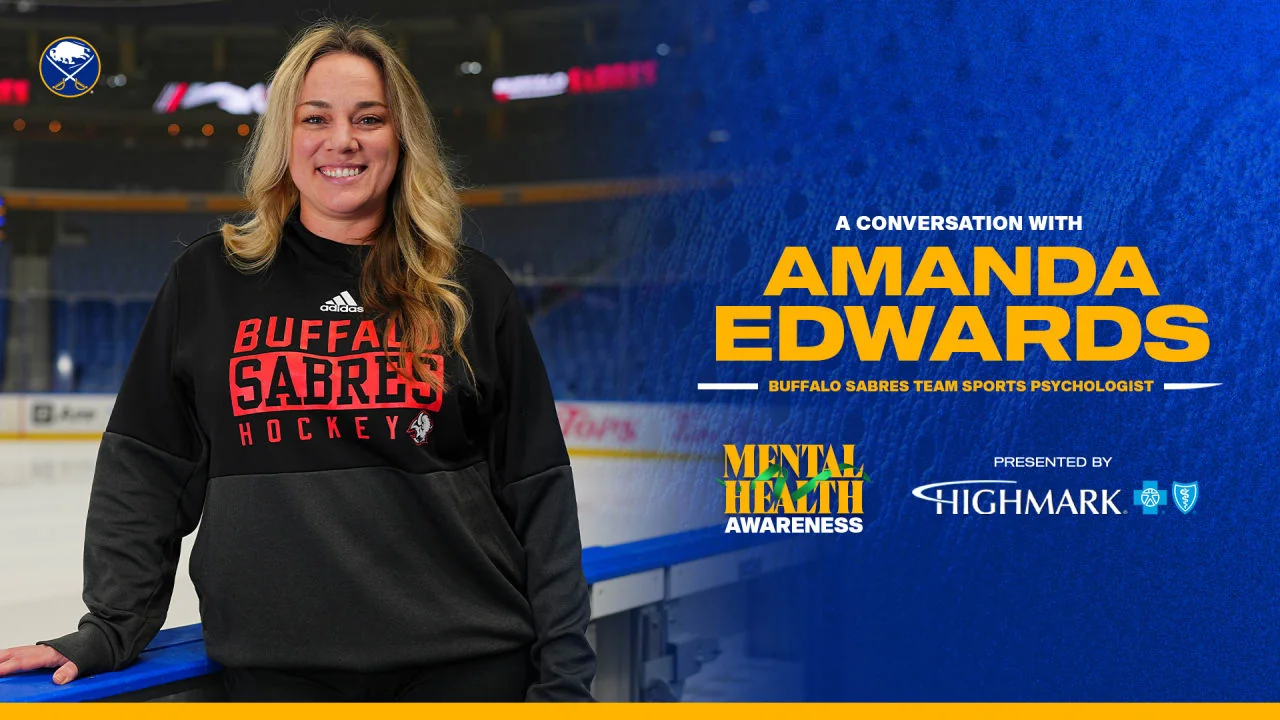
- Amanda Edwards discusses her role as the Buffalo Sabres’ team sports psychologist and how she helps players with mental health.
- Edwards emphasizes building trust through casual interactions to connect with athletes who may be wary of new voices in their lives.
- The Sabres are hosting a Mental Health Awareness Night, highlighting the importance of mental wellness in professional sports.
- Edwards shares insights on how she helps players regain confidence and cope with injuries and long road trips.
Casual Connections: Amanda Edwards’ Approach to Sports Psychology
Amanda Edwards, the Buffalo Sabres’ team sports psychologist, has built a reputation for not just focusing on the game but on the player as a whole. “A lot of people say athletes are people too,” she notes, “but actually, athletes are people first.” This philosophy guides her work, starting with casual, unscheduled conversations over breakfast in the team cafeteria.
Edwards explains that these interactions are crucial for building trust and understanding. “They see me around, I’m approachable, I’m nice,” she says. “But the NHLers, they have so many different kinds of voices in their ears. They have body specialists, they have mindfulness coaches, they have agents and former coaches and teammates.” Her approach is to be accessible and build relationships over time.
The Sabres’ Mental Health Initiative: A Step Forward
Ahead of Mental Health Awareness Night at KeyBank Center, Edwards discusses her work with the team. “Trust is built over time,” she emphasizes. “I’m circling back to these casual interactions with guys.” This approach ensures that players feel comfortable approaching her for support.
The event, presented by Highmark Blue Cross Blue Shield of Western New York, aims to raise awareness and celebrate mental health. Edwards’ work extends beyond the ice, helping players at all levels and throughout New York State through her private practice in Amherst. “A really well-adjusted, mentally well person/athlete is going to perform the best,” she asserts.
Supporting Players Through Adversity
“I work on both on-ice and off-the-ice stuff,” Edwards explains. “It’s pretty close as a 50/55 split.” She highlights how mental health affects physical performance, noting that social support from the medical team is crucial for recovery after an injury. “There’s good sports psychological science that says the best predictors of a successful return to play: things like social support, getting consistent messages,” she adds.
Edwards also addresses the challenges faced by players during long road trips, particularly sleep issues. “Sleep affects everything,” she explains. “It affects your mood, how you’re feeling, how much energy you have.” She uses various tools and techniques to help players manage their mental health while traveling, often meeting with them over Zoom or text.
A Winning Mindset: The Impact of Team Success
The Sabres’ recent success has not changed the nature of her job. “Winning really helps the vibe, the energy, the motivation,” she says. When things are going well, they focus on optimizing performance; when things aren’t, they work on resilience and staying positive. “We’re trying to be consistent with that,” she adds.
Edwards concludes by emphasizing the importance of celebrating mental health. “It means a lot to me,” she says. “I am so excited for this event.” The Sabres’ Mental Health Awareness Night is not just about acknowledging issues but promoting wellness and strength across all athletes, on and off the ice.
For more insights into how the Buffalo Sabres are supporting mental health among their players, visit Sabres.com.